The best time to see the northern lights
Updated
The best time of night is roughly 10pm to 2am local, when the aurora is usually strongest, and the best months are around the March and September equinoxes, when geomagnetic activity runs about double the solstice rate. On any given night, three things have to line up: the Kp index reaches the level your latitude needs, the sky stays clear, and you are standing in a dark spot with an open view to the north.
Right nowKp 0.00as of See every state
Aurora forecast and conditions:swpc.noaa.gov.
Best months and best hours
Aurora activity is concentrated in a few hours of the night and a few weeks of the year. The table below lists those windows and the reason each one matters; months outside them are usually quiet.
| Window | Best | Why |
|---|---|---|
| Time of night | 10pm to 2am local | The spot under the auroral oval sits deepest then, near magnetic midnight. |
| Months | March and September | Geomagnetic activity peaks near the equinoxes, about twice the solstice rate. |
| Worst months | June and July | Nights are short, and far north the sky never gets properly dark. |
| Moon | New moon week | Bright moonlight washes out faint displays. |
| Solar cycle | Solar maximum, declared October 15, 2024 | Cycle 25 recently peaked, so elevated activity should last another year or more. |
| 27-day rhythm | Every 27 days | Coronal hole streams repeat on the Sun's rotation, so active windows return on that cycle. |
The equinox effect comes from the way Earth's magnetic field tilts with respect to the solar wind. Around March and September the field lines link up most easily, so even a modest solar gust can produce a bigger response. It is worth planning a trip around those weeks, but a strong storm can arrive in any month.
Start with the number your state needs
Every latitude has a Kp threshold, the planetary index that roughly says how far south the aurora dips. Northern Michigan starts seeing it around Kp 3. Boston and Seattle need about Kp 5. Denver and Columbus hold out for Kp 7. Before you drive anywhere, check the Kp reading for tonight and your state's threshold. If the field is quiet, no amount of driving will fix it.
Get the timing right
- Plan for magnetic midnight, roughly 10pm to 2am local, when your spot sits deepest under the oval.
- Give it at least an hour: a sky that looks calm can brighten without warning.
- Target the weeks around the March and September equinoxes, when geomagnetic activity runs about double the solstice rate.
- Skip far-north summer if you can. Fairbanks, Alaska, runs its aurora season from August 21 to April 21 because the summer night never gets fully dark.
- Keep the Moon on your side. The week around new moon is best; a full moon drowns faint displays.
Pick the right spot
- Get away from town. Even a small city's glow on the northern horizon competes with the show.
- Find an unobstructed view north. From the lower 48 the aurora usually hangs low on the horizon, not overhead.
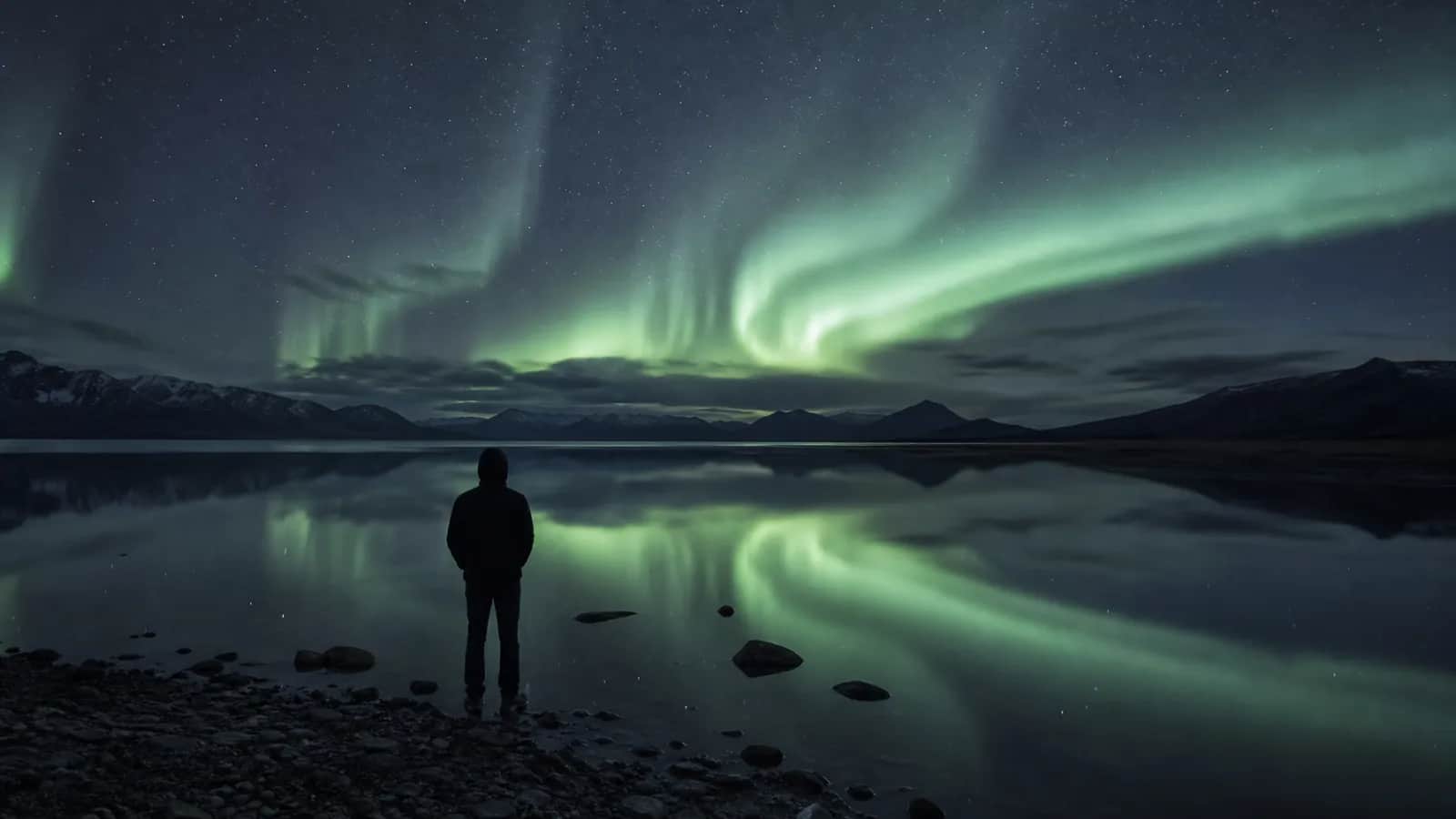
- A north-facing lake shore gives you both a clear sightline and a reflection to double the view.
- Let your eyes dark adapt for 20 minutes, and keep the phone screen dimmed and away from your face.
Photographing it, including with a phone
The sky may look empty to you, but a camera records color your eyes cannot resolve. Take a test shot. A greenish band in the frame is a sign the aurora is real and may strengthen.
| Setting | Start at | Why |
|---|---|---|
| Exposure | 3 to 5 seconds | Several seconds of exposure lets the color show while the stars stay sharp. |
| ISO | 1600 to 3200 | Raise until the histogram lifts off the left edge. |
| Aperture | Widest, f/2.8 or wider | Lets in the most light. |
| Focus | Manual on a bright star | Autofocus hunts and fails in the dark. |
| Support | Tripod or the ground | Anything over a second needs it to stay still. |
A phone works best propped on a solid surface with night mode on and the flash off. If manual or pro mode is available, set the exposure to about three seconds; it beats the automatic result.
A realistic expectation
In the mid-latitude United States, expect a pale arc that hangs low on the northern horizon rather than the overhead curtains from viral videos. Those pictures come from Alaska, Iceland, or northern Scandinavia, and they are usually long exposures. A real aurora can still be a good night, but it will probably look quieter than the photos.