Kp index, explained
Updated
The Kp index is a 0 to 9 scale that measures global geomagnetic disturbance. At Kp 5, the oval's edge reaches about 56 degrees, placing Boston, Seattle, Minneapolis, and Portland, Maine, in range. Higher Kp pushes the aurora farther south.
Right nowKp 1.33as of See every state
Aurora forecast and conditions:swpc.noaa.gov.
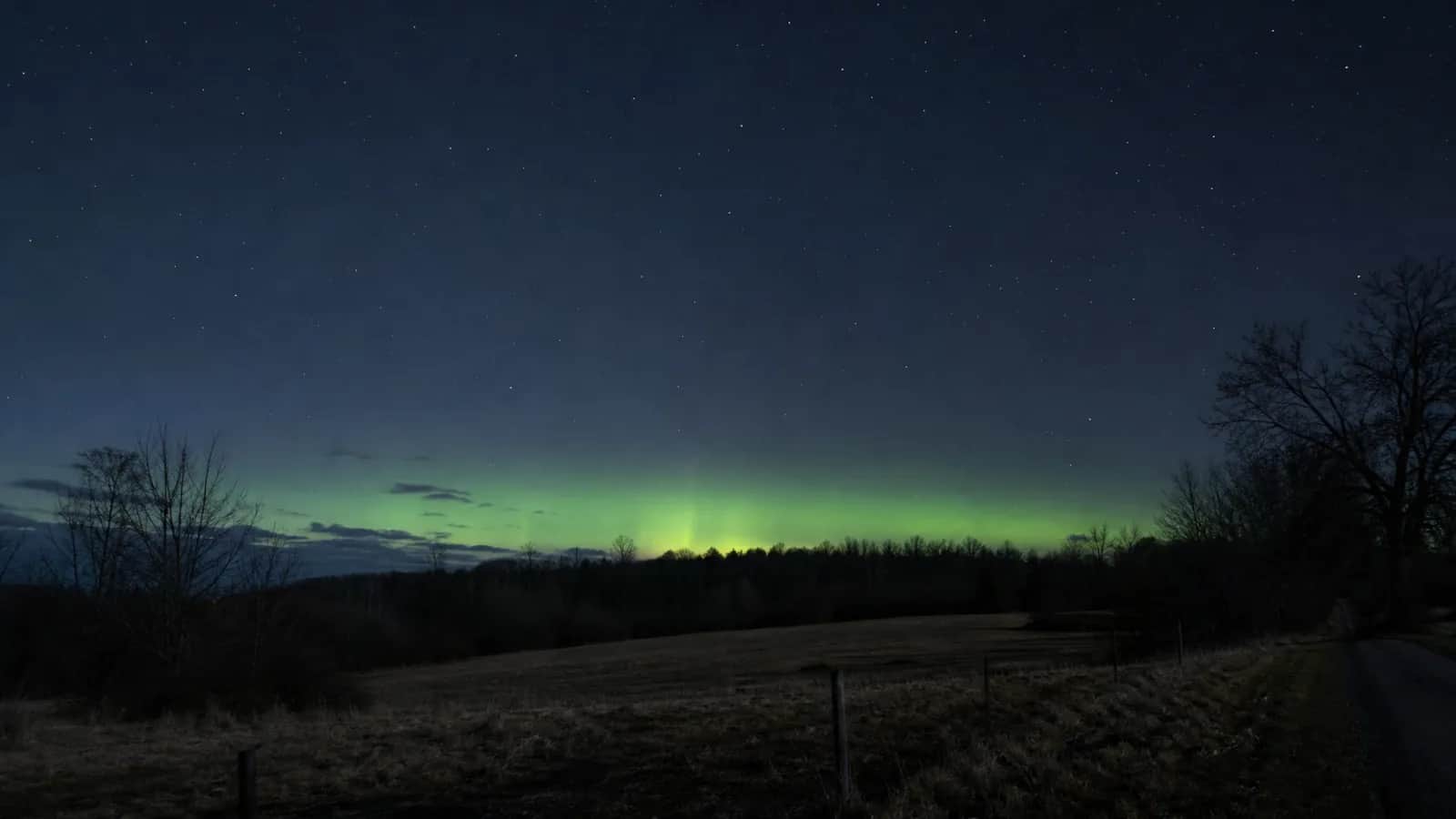
What does each number mean?
The Kp index condenses planetary geomagnetic activity into a single number from 0 to 9, reported for each three-hour window of the day. A higher Kp means the auroral oval widens and its southern edge moves closer to the equator. The table below shows what each Kp value generally means for the oval's geomagnetic latitude edge and which populated areas fall within it.
| Kp | NOAA storm level | Oval edge (geomagnetic) | Typically in range |
|---|---|---|---|
| 0-2 | None | 62-67° | Northern Alaska, northern Canada |
| 3 | None | 60° | Upper Michigan, northern Maine, northern Minnesota |
| 4 | None | 58° | Much of Minnesota, Wisconsin, Vermont, Washington |
| 5 | G1 Minor | 56° | Boston, Seattle, Minneapolis, Portland ME |
| 6 | G2 Moderate | 54° | New York City, Chicago, northern Ohio |
| 7 | G3 Strong | 52° | Denver, Columbus, Kansas City |
| 8 | G4 Severe | 50° | Northern California, Oklahoma, Virginia |
| 9 | G5 Extreme | 48° | Deep South, rare |
These positions are a guide, not a promise. The aurora glows at altitudes of roughly 100 to 300 kilometers, so you can sometimes see it low on the horizon even a few degrees south of the oval's edge. That altitude is why the guide is not a promise.
Where does the number come from?
The name comes from the German planetarische Kennziffer, meaning planetary index. The index combines readings from 13 geomagnetic observatories around the world. Each station measures how much its local magnetic field deviates from the quiet-day baseline, and the results are combined into a single figure for each three-hour block.
The settled Kp value is calculated after the fact. What this site shows is the estimated Kp that the NOAA Space Weather Prediction Center updates every minute, along with the time that estimate was taken. That estimate is current, not a lagging average.
Kp and the G scale
NOAA also uses the G scale from G1 to G5 to describe geomagnetic storms. The two scales carry the same information under different names; G1 through G5 correspond to Kp 5 through 9. News reports and forecasts usually mention the G scale, so it helps to know both.
- G1 (Kp 5): Minor storm, oval near 56°, Boston and Seattle in range.
- G2 (Kp 6): Moderate storm, oval near 54°, New York and Chicago in range.
- G3 (Kp 7): Strong storm, oval near 52°, Denver and Columbus in range.
- G4 (Kp 8): Severe storm, oval near 50°, northern California and Virginia in range.
- G5 (Kp 9): Extreme storm, oval near 48°, deep South in range, rare.
Why is a high Kp not a guarantee?
A Kp value tells you whether the aurora could be overhead at your latitude. It does not tell you whether you will actually see it. Several spoilers can intervene even when the numbers look good.
- Cloud cover is the first spoiler, since a thick overcast hides everything. Every state page on this site shows tonight's cloud forecast.
- Daylight kills a display, because the best shows are useless after sunrise.
- Full Moon washes out faint curtains, so a bright moon can hide a weak aurora.
- Light pollution from city lights can hide a show that is obvious 20 miles out in the dark.
- Timing matters, since the strongest activity usually falls near magnetic midnight, roughly 10pm to 2am local time.