What causes the northern lights
Updated
The northern lights happen when charged particles from the Sun, carried by the solar wind, are guided by Earth's magnetic field toward the poles. There they hit oxygen and nitrogen in the upper atmosphere, roughly 100 to 300 kilometers up, and the energy released as the atoms settle shows up as the aurora.
Right nowKp 1.33as of See every state
Aurora forecast and conditions:swpc.noaa.gov.
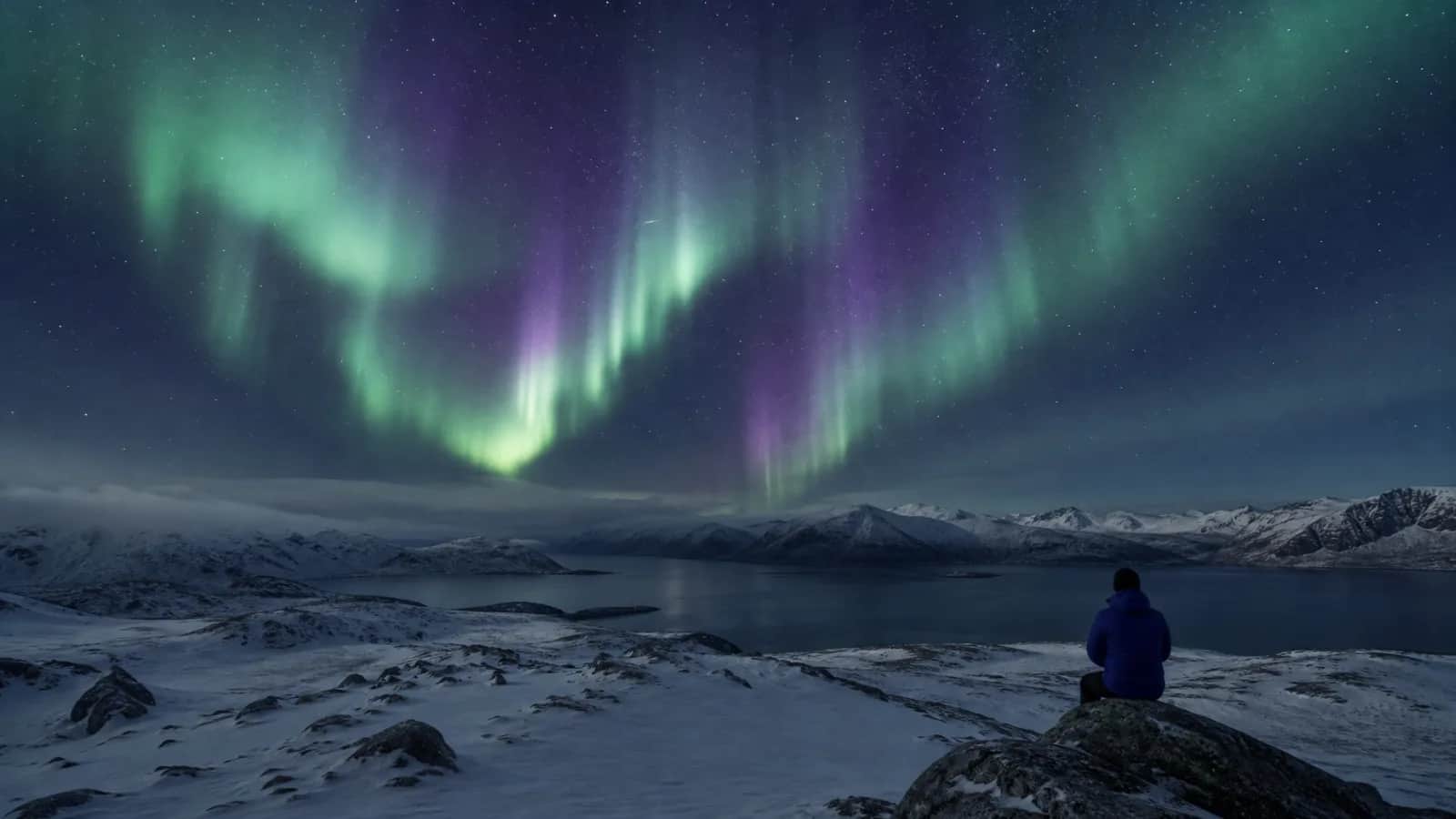
From the Sun to the sky
- The Sun constantly sheds charged particles, mostly electrons and protons. That stream is the solar wind.
- Earth's magnetic field deflects most of the wind, but the field gets stretched into a long teardrop shape by the pressure.
- When the solar wind carries a magnetic field that points south, it links up with Earth's field in a process called reconnection. That pours energy into the system.
- The energy accelerates particles down the field lines toward both magnetic poles.
- At altitudes of about 100 to 300 kilometers, those particles collide with oxygen and nitrogen, kicking electrons into higher energy states.
- The atoms settle back almost instantly, each transition giving off a photon. When enough photons fire at once, you see the curtain of light.
Why do the colors differ?
The color depends on which gas is hit and how high the collision happens. Bands stack by altitude, so a single display can show several colors at once.
| Color | Gas | Altitude | How often seen |
|---|---|---|---|
| Green | Atomic oxygen | About 100 to 150 km | Most common and brightest |
| Red | Atomic oxygen | Above about 200 km | In strong storms, above the green |
| Purple or blue | Molecular nitrogen | Below about 100 km | Lower fringe in strong activity |
| Pink | Nitrogen and oxygen together | About 100 km | Bottom edge of bright curtains |
The human eye is poor at seeing color in dim light. On the spot, a vivid green display can appear grey or pale to the naked eye. A camera with a three to five second exposure gathers more light than the eye can, which is why the pictures look different from the view outside.
Why is it an oval, not a cap?
The aurora forms in a ring around each geomagnetic pole, not a disc centered directly on the pole. That is because the magnetic field lines converge in a ring shape. The ring is called the auroral oval.
The geomagnetic pole is offset from the geographic pole, with its current position over the Canadian Arctic near Ellesmere Island. That offset pulls the oval farther south over North America than over Europe. For that reason this site reports by geomagnetic latitude, not by map latitude.
Why are some years better?
The Sun runs on a cycle of roughly eleven years, going from quiet to active and back. Near the peak, there are more sunspots, flares, and coronal mass ejections, which are huge eruptions that drive the strongest storms. On October 15, 2024, a panel from NOAA, NASA, and the International Space Environment Service (ISES) announced that Cycle 25 had reached its maximum period. Elevated activity is expected to continue a year or more after that.
Two kinds of solar events drive the aurora. A coronal mass ejection is a single eruption that reaches Earth one to three days later and can produce a severe storm with little notice. A coronal hole is a gap in the Sun's atmosphere that lets a fast stream of particles escape. Because the Sun rotates once every 27 days or so, these streams recur on a fairly regular schedule.